Walk the expo floor at any event tech show and you’ll get a facial recognition demo before your first coffee. Attendee steps up, camera blinks, badge prints, line keeps moving. It’s a great demo, and it’s been a great demo for years now.
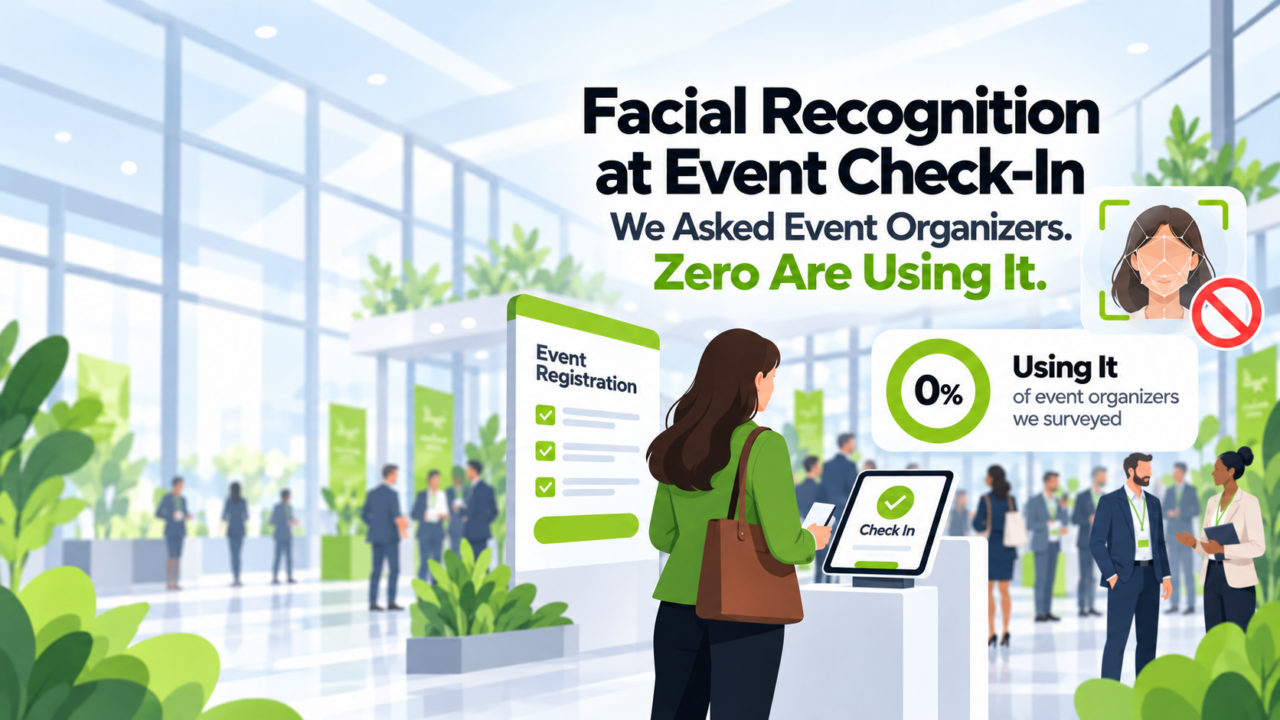
So, we asked 26 event organizers where they actually stand on it. The share using facial recognition at check-in today, or actively planning to, came back at zero. Nobody’s piloting it and nobody has it sitting in next year’s budget.
of the 26 organizers we surveyed are using or actively planning facial recognition check-in
Twenty-six responses is a directional read rather than a census. The reasons organizers gave are more interesting than the headline number.
The 27% are the group to watch, because they aren’t ideological about any of this. They’re waiting on two things at once: evidence the technology is safe to deploy and evidence it earns back what it costs. Those conditions rarely show up in the same quarter, which is roughly why “interested” has stayed “interested” through several budget cycles.
The 58% are a different conversation. They’re not asking for a better privacy policy or a tighter SOC 2 report. They’ve decided the category doesn’t fit their event, and no feature roadmap is moving them this year.
We asked organizers to pick their top two concerns. Here’s how that came back.
| Concern | Share |
|---|---|
| Privacy and data security | 65% |
| Attendee acceptance and pushback | 46% |
| Cost and ROI uncertainty | 27% |
| Legal, compliance, and state regulation (BIPA, CCPA) | 23% |
| Accuracy and reliability | 15% |
| Implementation complexity and integration | 8% |
| No major concerns | 4% |
Accuracy came in at 15% and integration complexity at 8%, and those happen to be the two problems most of the engineering money in this category has gone toward: better matching under bad convention center lighting, cleaner API handoffs into the registration system, faster enrollment.
Accuracy is something you can pilot your way out of. Run it at a regional meeting, measure your false rejects, fix the lighting, staff a fallback lane, publish the numbers. Six months later you’ve got a defensible system and a slide to prove it.
Attendee acceptance doesn’t work that way, and association organizers feel it most sharply because the people in the registration line are members who vote, renew, and sit on committees, and at least a few of them have your board chair’s direct email plus no hesitation about using it.
One member forwarding your registration page upward with “are we really doing this?” in the subject line can generate a thread, a board question, and a policy review, none of which showed up anywhere on the ROI worksheet you built to justify the purchase.
Corporate teams hit a version of the same thing from a different angle. Scanning employees into a sales kickoff raises the question of whether consent from someone who reports to you is consent at all, and HR usually has a settled opinion about that.
Your upside is a faster registration desk, measured in seconds saved per attendee. Your downside is a member complaint cycle, a local news segment, or a claim under a state biometric statute. Those don’t belong on the same scale.
One ordering in the data deserves more attention than it gets: cost and ROI uncertainty (27%) landed ahead of legal and regulatory concern (23%). A real slice of this industry isn’t primarily frightened of litigation. They’re unconvinced the thing is worth buying.
Which is fair. A well-run QR self-service flow with enough kiosks and real staffing in the first ninety minutes already clears lines fast. Whatever biometrics adds on top of a competent badge-scan setup gets measured in seconds per person, and seconds per person is thin justification for standing up a biometric database plus the compliance program that has to babysit it.
Most check-in pain was never a technology gap anyway. It’s an operations problem wearing a technology costume: too few kiosks, a badge printer nobody tested on site, a pre-registration file that imported badly at 6 a.m., one volunteer covering a line built for four.
Three states have standalone biometric statutes. Illinois BIPA is the one that shapes behavior, because it carries a private right of action with statutory damages of $1,000 per negligent violation and $5,000 per intentional or reckless one.
The ceiling came down in August 2024, when an amendment limited a person to a single recovery no matter how many times the same biometric got collected the same way, and the Seventh Circuit has since applied that retroactively. That’s real relief if you’re deploying in Illinois, though it isn’t immunity and it does nothing for you in any other state.
Texas CUBI allows penalties up to $25,000 per violation, but only the Attorney General can bring them. Washington requires notice, consent, or an opt-out before a biometric identifier goes into a commercial database. On top of all that, the comprehensive privacy laws in California, Colorado, Connecticut, Virginia, and Oregon classify biometric data as sensitive, which generally means opt-in consent before you process it.
Now remember that your show moves. Chicago in 2027, Austin in 2028, somewhere on the West Coast in 2029. A check-in stack that was clean at last year’s venue can land inside a materially different legal regime the next time you sign a convention center contract.
This needs a named owner, not a one-time sign-off from counsel that gets filed and forgotten.
The roadmap worth building is the one aimed at what organizers actually flagged.
- Speed without biometrics. Pre-printed badges, mobile check-in, self-service QR scanning, honest kiosk density, and correct staffing at the opening rush solve the overwhelming majority of line problems.
- Consent people can recognize as consent. Opt in at the moment of collection, write it where someone will actually encounter it, and provide a non-biometric path that isn’t slower as a penalty for choosing it.
- Data minimization by default. Collect what the badge needs, decide the retention window before the event, and be able to say where the data lives and when it disappears.
- Configuration that follows the event. Whatever does get collected should be configurable by event, by state, and by attendee type.
The useful move is to stop treating biometric check-in as an inevitability you’re running late on, and start asking what the 27% are already asking. What would have to be true about safeguards, consent, and measurable return before this is worth spending attendee trust on?
Any vendor who can’t answer that in plain language has answered it.
A2Z Events runs check-in on badge scanning, self-service registration, and on-site badge printing in one connected system.
You get the attendance and session data your sponsors, board, and leadership keep asking for, while collecting far less sensitive information than any biometric deployment would require.
See How A2Z Events Handles Check-In